Thursday, March 05, 2009

Oil and Water


My friend Juan, who has a college degree and used to run a tourism project in the Kichwa community where he grew up, gave me two reasons that he is now working for Ivanhoe, a Canadian oil company contracted by the Ecuadorian government to drill in the most populous region of the province, where he and I both live: People in the cities benefit from tourism dollars, but not the communities. And heavy crude is breaking through the surface, so it’s a health hazard to leave it there.

There are counter arguments to Juan’s statements, but I can't deny his concerns about work. I also know, as does he, the atrocious record that some oil companies have in the northern Amazon. Chevron-Texaco’s unfettered oil drilling dumped 30 times more crude in the rivers than was spilled during the Exxon Valdez disaster, and cancer is rampant in that area.

Everyone here knows what happened in the north, and some trust that the government will implement sufficient controls to prevent widespread environmental destruction. Others see that the government has already broken its own laws, including allegations of “serious irregularities” in the Ivanhoe deal. And then there is the fact that Ivanhoe’s technology for converting heavy crude (all that exists here) into light crude has been tested only over the last few years and on a small scale in Bakersfield, CA. Living on a tributary of the Amazon River and in one of the most biologically diverse areas in the world, we are a long way from Bakersfield.

It was one thing to read about these conflicts from my former apartment in the San Francisco Bay Area. Now I can watch them unfold right outside my door. Ivanhoe thinks it will be able to extract more than 100,000 barrels a day about 2 miles from where I live in Tena.


The government finance directors think the oil revenue will pay for health and education programs. Some locals think Ivanhoe will shower them with jobs or money for infrastructure. Politicians think they’ll earn extra cash and votes. I think it could be a disaster, and not just environmentally. Coca and Lago Agrio, in the heart of the Chevron-Texaco mess, are notoriously dangerous, drug-plagued cities. Tena is so safe that I don’t even bother to lock my door sometimes.


But rather than give in to fear, I’m hoping that the delicious incompetence of the Ecuadorian government, combined with falling oil prices, will buy a little time. Meanwhile, some friends of mine and I have started Amazon Partnerships Foundation to help communities find practical ways to use and renew natural resources to meet their basic needs so that jobs promised by oil companies are not their only option.

We’ll provide grants and project management training to communities that want to design and implement their own projects to protect the environment or promote the conservation values of traditional Kichwa culture. One grant could supply a women’s group with training to market their hand-made jewelry and baskets, earning them income to buy food and school supplies for their kids. Another grant could help a community start a sustainable forestry project so they could reforest part of their land for conservation and have a reliable source of income through lumber sales.


For everyone, it's an experiment in coping during difficult times, and none of us has any guarantee of an outcome that will ensure happiness and well-being. But one thing this place teaches us foreigners is that small victories matter. And when I look out at the lush foothills and rivers and imagine what could disappear . . . whatever I might see ten years from now, I want to know that at least I didn't shy away from the battle.

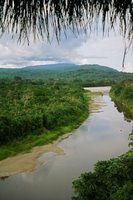
Thanks to Sadie Funk for the river photo.

Labels: , , , ,

Friday, November 21, 2008

Encounter with the President

No, not that President.

It was an overcast Sunday, and I was hanging out with my friend Andrea, who lives in an upscale Quito neighborhood. As someone raised in U.S. suburbs, I found it all a little too familiar: paved sidewalks and tree-lined medians surrounding modern apartment buildings and some large houses, electronic gates around the housing developments, and inside everything finished and manufactured. I saw no naked light bulbs screwed into ceiling sockets, no slap-dash paint jobs, and no window cracks sealed with putty.

We stood in line at the ice cream shop at an outdoor mall near her apartment, minding our own business, when the President of Ecuador, Rafael Correa, strolled in with his family and took his place two people behind us. Completely star-struck as soon as I laid eyes on him, I fixed my gaze on the chocolate-covered waffle cones for fear of gawking should I turn my head in his direction. Andrea casually mentioned that she had taken a class with the former professor of economics. Incredibly, he recognized her. More incredibly, he struck up a short, polite conversation with her. He was distracted, so I took the opportunity to gawk uninhibited.

After finishing our ice cream a mere two tables away from el Mandatario, who was not sitting in a bullet-proof chamber or surrounded by heavily armed men, Andrea approached him. She thanked him for inspiring her to pursue her current job with a leading environmental firm that analyzes financing possibilities for the emerging carbon market. It just so happened that the President’s team was reviewing a proposal for protecting one of Ecuador’s major jungle reserves as part of a global cap-and-trade scheme; he wondered, could her firm take a look and give his team suggestions? She handed him her business card.

No, I’m not making this up.

I watched the President shake hands and have his picture taken with the customers and store employees and kiss babies, all under the watchful eye of five or six policeman who leaned against their police cars. Of course a scene like this is more possible in a country of 12 million people, roughly eight times the number that will see Barack Obama be inaugurated in Washington D.C. in January. And there is certainly a significant downside to all of this familiarity. The Ecuadorian government is famous for its nepotism—I have a whole blog’s worth of stories about my dealings with inept bureaucrats who got their jobs because they are the son of the governor’s best friend’s daughter’s cousin.

On the other hand, when six degrees of separation are reduced to two degrees, does that open the door to share new good ideas, not simply get you a fat government paycheck? After all, Rafael Correa was right there in the ice cream store talking to my friend about environmental policy. Would a casual conversation about dry ecological toilets over a bowl of mango sherbet be that far-fetched?

I’ll keep you posted.

Labels: ,

Sunday, October 26, 2008

Uncertainty's Dance

My friend Natalia and I were talking recently about the world economic crisis, how it might impact Ecuadorians like her, and how it might impact foreigners like me with work-based visas from U.S. non-profit organizations that are already starting to brace themselves. “For us, we live with uncertainty everyday, so we’re used to it. But for you guys,” she sympathized, “it must be really hard.”

Just to put it in perspective, in the last 18 months, the price of 40 kilos of chicken feed—corn—in Ecuador has gone from $10.50 to $24, an increase that is part of the story of the global food shortage. A lot of chicken farmers here feel the squeeze, as do corn growers in the region where I live, who have not gotten significantly more for their crops. Prices for basics like rice, sugar, and eggs, have shot up 30% according to government statistics, a difficult burden for families who make on average about $250-$400 per month. And if you make $70, as thousands of families in the Amazon do, it’s just about insurmountable.

From what I’ve read and heard, food prices are a perennial campaign issue in this country with its small middle class, weak educational system, and few large industries, though the government has been subsidizing staples for the last several months. As with many other issues, the uncertainty of whether the average family will put enough food on the table, (I mean food like a plate of rice and some plaintains, forget about vegetables or dairy or protein) is one people learn to live with. When my friends here who read about the chaos in the U.S. and world stock markets ask me if it’s really as bad as it sounds, the expression on their faces falls somewhere between stunned and vaguely concerned, whereas I know my face shows something more akin to dread. But I think that’s because I have not yet dropped that particularly seductive American viewpoint that we have total control over our destiny.

So what else to do but learn how to dance with uncertainty, a process I started before I left the U.S. and one that perhaps subconsciously drew me to this place that could make one a master at it.

A couple of things I've been doing to improve my dancing skills . . .

1. Take a cheap vacation to a mini-utopia.


This is Salinas, a small town in Guaranda province that over the last 30 years transformed itself from a hamlet of straw and mud huts to a town of more than 20 locally run cooperatives that make everything from cheese and chocolates to essential oils.

People don’t live high on the hog here, and the system is far from perfect, but unlike many places in Ecuador, most people have jobs and the young people come back to live after they finish their education. My short trip to this center of micro-economy helped me forget nettlesome macro-economic problems.


2. Watch the sunset. Something that is both predictable and beautiful always brings me a sense of calm. And attention is all I have to pay.


Labels: , ,

Sunday, April 20, 2008

We Are Pioneers: Supermaxi, Biodegradable Bags, and the Women of Cuya Loma

Happy Earth Day from the Amazon! I’m celebrating by writing this blog and participating in the CALL FOR CLIMATE campaign to demand that Congress act now to reverse global warming. Any other earthlings who feel so inspired, please pick up your phones on APRIL 22 and dial your Senator and Representative: 202-224-3121.

For five hours over a partially paved, mostly potholed “highway,” I sat on the bus from Quito to Tena with my plastic shopping bags trapped between my feet. I enjoyed the cloud forest whizzing by as we descended from the Andes to the lowland jungle, feeling a little less guilty than usual after my trip to Supermaxi in Quito. As the name implies, Supermaxi is the largest nationwide grocery and household goods store in Ecuador and sells two things I find I can’t buy in Tena and can't live without, despite my efforts to “live local” and “get off the grid”: dijon mustard and balsamic vinegar.

Fortunately, Supermaxi has gotten the memo about the climate crisis and has replaced its conventional plastic bags with biodegradable ones, which announce “We Are Pioneers.” In the grand scheme, it’s a small step of course, but it shows decent corporate leadership and helps me feel better about my carbon footprint:

+ 6 jars of imported dijon must
ard
- 1 biodegradable bag
+ 1 5-hour diesel bus ride
- 1 4-hour trip in private car
= how much carb
on I’m putting into the atmosphere?

Well, the math is beyond me, but that’s what these nifty carbon calculators are for.


Though excellent laundry services abound in Tena (80 cents a kilo gets even your underwear washed, dried, and ironed), most women (women) wash their family’s clothes in big cement sinks at home. Most people can’t afford to buy washers and dryers, and even the wealthy tend to relegate the task to their maid (again, a woman). Since I have a cement sink and clothes line, I do the same with most of my clothes. It took only two or three weeks of sudsing, scrubbing, wringing, and hanging for me to appreciate both modern technology and the feminist movement. All the books and articles I’ve read on gender roles seemed like abstract musings compared to what I learned washing my own clothes by hand in Ecuador.

Multiply that work by seven people (six kids and one husband, an average family size) and it’s easy to understand why, when I visit rural communities, the women are eager to have electricity, running water, and roads, even though they often come at enormous cost to a fragile rainforest environment. The men want those things too, but technology is more a matter of convenience for them. Though Kichwa men generally help around the house more than other latino men, domestic chores are still optional. Not so for the women. Technology could improve their daily existence dramatically, leaving more time for education, a professional career, or simply the freedom to choose what they want to do with their lives.

Does this freedom, as a result of modernization, inevitably lead to the production of trillions of plastic bags? That’s what I wonder when I talk with communities about building water or sanitation “systems” that solve one urgent and important problem but create ten others that burn on a slower, but no less powerful, flame. I’d like to think that freedom—and creativity—can lead directly to solutions that improve the standard of living for the poor and marginalized and skip the step we industrialized nations have taken in the development process, the one in which industries pollute the planet and exhaust natural resources then later scramble to fix things.

It has taken Supermaxi less time to adopt the biodegradable bag than it’s taken Wal-mart to demand its vendors reduce product packaging. And 13 women, including the president of the community of Cuya Loma, will be pitching in to build dry composting toilets for their houses next weekend (more to come on the marvel of the dry composting toilet). So perhaps these are signs of a new kind of pioneering spirit to work with the earth, not against it.

Labels: , , , , ,

Monday, October 29, 2007

Fruits of Change

After a long hiatus, the blog is back, and I am back in Ecuador, this time to live. I’ve chosen Tena, a city in the Amazon jungle with a population of 16,000, as my home base. When I tell people, especially Ecuadorians, where I live, I get a wide range of reactions, from impressed amazement to bewildered disbelief. Even though five years ago I never would have imagined myself taking up residence in the jungle, it’s neither as adventurous or as dangerous as it might sound. My comfortable apartment has wood floors and cement walls and a patio overlooking the mature fruit trees and ornamental plants that the landlords planted years ago. On mornings when I don’t have meetings or community visits, I sit out there with my coffee and observe the butterflies at work. I can go a week without seeing the same kind twice. So when people ask, “Why Tena?” (or “Why Tena!”), here is what I tell them:

Fruits that look like they come from outer space
: I discovered the anona when my landlady picked one from the tree that grows outside in the yard and brought it to me as a welcome gift. Though I haven’t been in the habit of eating fruit that resembles a porcupine, the inside of an anona is gooey and sweet, like tapioca without the disgusting globules. It’s great in cakes, and I plan to try to make ice cream with it next.


Lazy birdwatching
: Again, with my cup of coffee on the patio. No binoculars needed.


Inspiring neighbors
: Visiting different Kichwa communities for Global Pediatric Alliance, I’ve met a lot of people with little formal education but excellent ideas: One group wants to build dry ecological toilets so they not only will they have sanitation for the first time, but the toilets won’t contaminate the groundwater and will produce completely safe organic compost for gardens. A friend of mine, a father of six who has not had steady work for almost a year, has decided to take a huge risk and go into business for himself, converting a plot of family land into an Kichwa ecolodge. Another friend of mine, who has some university education, presented me with a ten-page proposal to train Kichwa women and young people to be community leaders after I casually mentioned that someday it would be interesting to collaborate on that type of project.


Fewer distractions
: Yes, I’ve got t.v. (but not cable) and yes, I’ve got internet (but no high-speed line in my home yet), and yes, my neighbors play salsa music or a compiliation of 80s American music that's a bestseller at the bootleg CD shops here, but despite all of that, I often find myself surrounded by quiet or the noises of nature. Somehow, having fewer things plugged into the wall or running on batteries, I find it it easier to read, write, and think.


Sunsets
: After a long, hot day in Tena fighting with the phone company or standing in lines to pay my utility bills, I walk home through town, across the airport tarmac (since the only flights are occasional a government prop planes, at dusk it’s turned into a running track and volleyball court), and watch the sunset over the lush mountains of Llanganates Reserve. Although many, many thousands of trees have been cut down in this area, the forests in the park are still in tact. The sun sinking behind those mountains reminds me that my human clock and the concerns it drives are, at the end of the day, insignificant.

Labels: , , ,

Wednesday, March 29, 2006

Day to Day in Tena

Here is a list of some things I encounter as part of daily life in and around Tena:

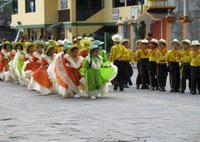
Kids on parade

Dogs on rooftops

Vendors on busses selling fruit, shishkabobs, sunglasses, herbal remedies, CDs, razors, wallets, and anything else they can think of

The jungle and swimming in the river


Neighbors sitting outside on their patios chatting, literally, for hours

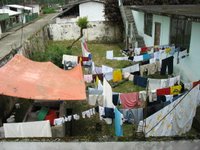
Fields of laundry


Musical garbage trucks—On garbage day, the trucks drive up and down the streets playing a music-box tune to let people know they should bring their garbage out to the curb. Although the streets are littered, people don’t leave garbage bags out because the trash will rot in the humidity or be torn to bits by stray dogs.

Entrails and meat cuts hanging in open-air butcher shops

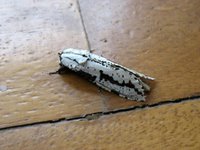
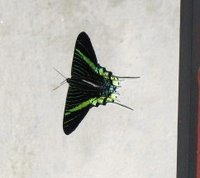
Impressive insects—I discovered the black butterfly, with a wingspan the length of my hand, inside the house

Labels: , ,

Tuesday, March 14, 2006

Guayaquil: The Extreme City

If you spend much time in Quito, the political capital of Ecuador, you get accustomed to hearing stories about Guayaquil, the economic capital of Ecuador. The huge port city is twice as populous and sprawling as mountainous Quito, is sweltering with humidity much of the year, has an even more extreme gap between rich and poor, and is supposedly riddled with thieves and murderers. Being from Oakland, I wasn’t overly daunted by this last fact, plus I was going to get a brief tour of the city from a local whom I figured could help me stay safe and alert.

My guide was Lupe, born and raised in Guayaquil. She is a doctor who works in the city four days a week, then travels 3 hours each way by bus to work in rural communities every weekend. She’s a small woman (at 5’2”, I tower over her) but formidable. She speaks at close to the speed of light, tells you exactly what she thinks, and uses her hands to dramatic and sometimes dangerous effect, especially if you are a non-native speaker leaning in close to try to understand what she’s saying.

She met me at the airport and launched into a detailed, rapid-fire story about her work, all the while leading me across a busy six-lane thoroughfare to catch a bus to her house. I realized then that thieves and murderers would probably be the least of my problems. Following the story, keeping track of my belongings, and trying not to get run over by maniacal drivers gave me a new appreciation for the term “multi-tasking”. By the time we squeezed onto the bus and Lupe, my bags, and I wedged into the last two hard plastic seats, I was exhausted. I’d been in Guayaquil 15 minutes.

I still don’t know what exactly Lupe said or what exactly I saw on the bus ride to her house. My receptors were on overdrive. But once I let go of the hope that I could make sense of things, I started to enjoy the chaos. I know we passed a lot of small, crammed together cinderblock buildings with rusty signs. The storefronts were blocked by bars, like at a bank teller window, through which people exchanged cash for soap, fruit, beer, diapers, or whatever else was on the shelves. People were out and about in shorts and flip flops, and we passed a lot of small restaurants that grilled all kinds of animal innards in big street side barbecues.

Lupe lives with her mother, father, sister, brother-in-law, and eight-month-old nephew in a working-class neighborhood in Guayaquil, which means she lives in a poor, but not desperate, part of the city. Although Lupe comes from a family of professionals—one sister is a pediatrician, another is a teacher, and one of her brothers is an accountant—they earn less than an Ecuadorian middle-class wage. Their house is their only investment. It’s an attractive if quirky building: stairs take you up a flight so you can go down a level and doors seem to appear out of nowhere. After spending a few hours there, I got the hang of the layout, in which everyone has individual space, though most of the time the family is together in the living or dining room.

Lupe and I ate lunch with her sister and mother, who welcomed me like their favorite neighbor who’d just come back from a long trip. We talked about the kind of food I like, how Arnold Schwarzenegger ended up as governor of California, the pending Andean Free Trade Agreement, Ecuadorian celebrities, and the weather. They also made sure I knew what a fabulous city Guayaquil is, from the climate to the variety of things to do to the major economic interests controlling the country from their hometown. Later, Lupe took me on a tour that began as an errand to buy an AIDS prevention video for the health promoters she works with, and that’s when I got a taste of the city her family described.

A couple blocks from her house, we caught the bus near the tributary of the river that runs through Guayaquil, one of the filthiest I’ve ever seen. Trash floated on the caramel-colored water, which rose to the level of the houses that seemed to grow out of the weeds. The bus dropped us off somewhere near the commercial center. I followed Lupe through an immense warren of stalls selling everything, including more bootlegged videos than I’ve ever seen in my life. Lupe, of course, charged through the maze with utter confidence, while I clutched my purse to my side and hustled to keep up with her, lest I be lost in Ecuador’s answer to Marrakech. Then we emerged from the central market onto a vast tree- and skyscraper-lined boulevard and walked several blocks to the Malecon, which fronts the river. But here, the water gleamed a natural green and reflected the thick cumulus clouds and lush ve
getation on the opposite bank. And the Malecon itself is a marvel—several miles of boardwalk comprised of botanical gardens, modern sandstone and metal architecture, impressive monuments to Ecuador’s founding fathers, museums, shopping, and gourmet restaurants. The Malecon is proof that Guayaquileños have a vision for a world-class city.

The Malecon leads to an artsy hillside neighborhood called Cerro Santa Ana, a collection of colorful houses, restaurants, shops, bars and galleries. We climbed more than 400 steps to the top of the hill where a new lighthouse, modeled on the original from the 1800s, sits. From there, you have a remarkable view of the city and where the money goes. Directly below the summit is a slum slated for redevelopment as a tourist complex, to the east is the Malecon and the business district, farther afield is the area where Lupe and her family live, which was paved with streets and sidewalks just a few years ago. Next on the city’s list, Lupe told me, is to clean up the river that runs through her neighborhood. Short as my trip was to Guayaquil, I got the impression that just as the people, the weather, and the pace of life are more intense, the process of correcting imbalances between rich and poor is probably that much more painstaking, and changes that much more hard won. But perhaps those incremental victories are part of what makes Lupe so proud of her hometown.

Labels: , , ,