Sunday, January 04, 2009

The Old Man Burns Again


On December 31, 2007 I was a mere observer of the “Año Viejo” tradition, the one in which Ecuadorians of all races and classes stuff old clothes with newspaper, scrap wood, and whatever other combustible material they can find to make an “old man,” who represents the year about to end. Sometimes they add a papier-maché mask—of a devil, clown, cartoon character, politician, friend or family member—and a cigar or other accessory and light the whole thing on fire at midnight. You purge what you didn’t like about your own or others’ behavior in the previous twelve months, but you can also celebrate the good as well. In true Ecuadorian fashion, the “old man” can be whatever you want him to be. No pasa nada.


I decided that this year (last year) it was my turn to partake. Here you can see the sad but charming old man my friend Kelly and I made. We didn’t set out to make a Sponge Bob replica, but we’re beginners and I was fresh out of flour-and-water paste.


Kelly composing last thoughts for 2008.

Another part of the tradition is that you can stick notes on your guy. Again, these can be congratulatory or critical, but I opted for the latter. I’m not evolved enough to be able to burn what brings me joy. You can see that Kelly and I had a few things we wanted to bid adieu.


We burned our Sponge Bob and walked through the streets set ablaze as if Colombia had dropped a bunch of marionette bombs. New Year’s Eve here happens in the neighborhoods, and each usually has at least one bonfire into which everyone’s old man gets flung. Some people also write and post testimonies, either things they promise to do (or stop doing) or satirical send-ups of neighbors for everyone to see. On our way to the big bonfire in the central park, we passed one testimony of a man who promised not to complain to his wife so much when he comes home drunk in 2009.


It’s hard to decide which part of this tradition I like the most: making the doll, writing up my goodbyes-good riddances, lighting the thing on fire, or attempting to roast marshmallows over the glowing ruins. All I can say is that I felt liberated and optimistic watching our creation be reduced to ash. The people I allowed to upset me, my bad habits, the big global problems that are beyond my power to change were all transformed to the good in that fifteen-minute fire, simply through the recognition that it is never too late to begin anew.

Labels: ,

Tuesday, September 09, 2008

Picnic on the Rio Napo

When some Kichwa friends of mine invited my American friends Jason and Mary and me on a picnic, I knew enough not to expect a grassy lawn with a wooden picnic table and a Weber barbecue. But I wasn’t expecting that I should have worn my rubber, knee-high wading boots. I should have known better.

We started off at Juan and Irene’s house, packed up the peeled oranges, papaya, and corn cobs from their farm, the old pots, knives, plastic cups and carving knives from their kitchen, plus the raw chicken, cheese, and chocolate chip cookies that Jason, Mary and I had brought. Then we crossed the paved road and headed down a steep slippery bank, where we had to proceed human-chain style to keep from pitching over the side. As we scaled down a rickety ladder that someone had built on the trail, I was wondering if there wasn’t an easier way to get to the river.

It turns out that we were going to Juan’s mother’s field to harvest some yuca that we’d be boiling over an open fire. With the tubers in our bag, we trekked another 20 minutes or so, fording a couple of slippery-bottomed streams, to arrive at a rocky bank on the Rio Napo.

Mary watches as Juan sets up the fire pit.

We set up camp, complete with palm-frond sun shelter, improvised fire pit, and delicious
cheese-stuffed roasted bananas (the less sweet kind, called “maduros”).

Peeling yuca in the shade of our natural umbrella.

Irene tending the maduros and chicken strips on our barbecue.

We feasted and some people swam (I waded) while Juan went fishing in the traditional Kichwa style with a hand-made net of thin palm fibers. I watched him throwing the net and diving in after it into the wide, fast Rio Napo.


Something about the river always makes me reflective, and I was thinking about how striking it was to watch someone with a college education and a computer in his house fish in the same way his great-great-grandparents did. I can’t think of anything I do that my great-grandparents did. Except travel, I suppose.

Packing up in the late afternoon, we took a shorter path back. Our Kichwa friends led all of us white people by the hand so we wouldn’t slip crossing the river. You learn to swallow your pride in situations like this. Groggy from the sun, I was glad to arrive and Juan and Irene’s house, where we drank chicha and ate the chocolate chip cookies, a novelty to our friends. As I heard a familiar distant roaring engine, I realized that I've adapted more to this environment than it might have seemed when the day started: I could distinguish from all of the other car noises the sound of the bus back to Tena.

Thanks to Jason Kaminsky for the great photos.

Labels: , ,

Friday, February 08, 2008

Carnaval 2008: I Ate a Worm

. . . and not for 2 million dollars or whatever those Fear Factor contestants get for their repugnant dares. The Chonta Kuru, a short fat worm with a distinctly worm-like appearance even when smoked over a fire in a banana leaf, is a seasonal delicacy around here. I’ve known about it, and avoided it, for three years. But at a meeting with some Kichwa folks from San Pedro, where GPA is helping build a potable water system, I learned that the community was going to build a floating bar and serve comida tipica (local cuisine) to raise some extra money at the Carnaval festivities just down the river in Misahualli. Wanting to support the group, I said I’d drop in for a bite to eat and later realized what I had committed myself to.

Really, the worm wasn’t that bad. Six came with my order and I could only bring myself to eat one, minus the head. It had the texture of overcooked shrimp but
was nicely salted and served with tasty pieces of hearts of palm. I washed it down (pretty literally) with chicha de chonta, a semi-fermented drink made, in this case, of palm. Normally chicha is made with yuca (I think it’s the same as manioc, which is a bland, fibrous tuber), and traditionally women chewed the yuca and spit it into a vat to aid the fermentation process. I’ve heard (and choose not to learn otherwise) that people skip the chew-and-spit step nowadays. I’ve tried chicha de yuca, but the drink made with chonta is much better.

But food is just a minor part of Carnaval — the real mission is to get as many people as possible, preferably strangers, soaking wet, covered with spray foam (kind of like Silly String), dunked in the river, covered with mud, drenched with beer, or even slathered with raw egg. In the day and a half I spent on the river at Misahualli, I was dry for about five hours. During the day there were bikini contests, concerts, canoe trips, and carnival rides, and at night there was traditional Kichwa music and dance, plus salsa and reggaeton, but always, always there was a spray of liquid coming from somewhere.

A friend of mine from the US complained that in Ecuador,
everyone is fair game at Carnaval—it’s not just about playing tricks on your friends. But that is one of the things I love about the holiday. In a society that is often strictly and blatantly segregated by race and class lines, Carnaval distributes the fun evenly for a few days. Little Kichwa kids can pelt mestiza ladies with water balloons, and most will shriek and laugh and possibly even return fire with spray foam. Taxi drivers will get squirted with water pistols if they leave their windows down, store clerks tag customers, neighbors chase each other with pots of water, and foreigners like me are probably the easiest prey of all. At the beach Lionel, ten-year-old son of one of my Kichwa friends, found me in crowd of several hundred and after his usual sweet hello threw a bucket of river water in my face. I got him back, though.

Labels: , ,

Sunday, January 06, 2008

Burning the Old Man


The first sign for me, never having spent the end of the year in Ecuador before, was the pile of headless stuffed figures dressed in jeans and button-down shirts on the street corner. I didn’t think much of it at first because on any given street corner, at any given time, you can find things from mangoes to DVDs to diet supplements. But when I started seeing stacks of the stuffed people on street corners all over Quito and an array of freakish masks, I asked. “Those are the old men,” my friend informed me.

The last few days of every year Ecuadorians pick out their old man, give him a face, attach notes to him conveying whatever sentiments, thoughts, etc they want to get rid of, and then burn the whole thing on the street. The old man, 2007, is reduced to ash, and for added affect, men don party dresses and wigs and parade around
as the widows of the old men. My guess is these are mostly straight men, based on the unsophisticated drag, but I’m sure some gay men get into the act to, since it’s the only time of the year when cross-dressing is widely accepted.

On New Year’s Eve I was in Cuenca, which I discovered is fairly buttoned-down during the holiday, but that afternoon people were busy
preparing a massive float for the midnight parade. The old men to be burned were none other than the Spanish Prime Minister, the King of Spain (am I the only person who didn’t realize Spain still has a king?), and Hugo Chavez. I didn’t get the joke until I saw the end-of-the-year news montages on TV: at a meeting in Chile earlier in the year, Hugo Chavez was insulting the Prime Minister, and the King, sitting between them, said, “¿Por qué no te calles?”—why don’t you just shut up? It wasn’t long before the King’s phrase got ripped to an MP3 file and downloaded as a ringtone on millions of Ecuadorian cell phones. As my Ecuadorian friend put it, “Chavez is Chavez. We all know how obnoxious he is. But on the other hand he’s still a head of state. You (referring to the King) can’t treat him like he’s one of your servants.”

So all three went up in flames as Ecuador prepared for 2008. But not all the old men were politicians. Here’s a baby Shrek (the movie is wildly popular here—I don’t know why) named Pipicho, the Kichwa word for penis. Who knows what notes were attached to that one . . .

Labels: , ,

Wednesday, April 12, 2006

This Is How We Dance in Caipirona

For as many times as I’ve suffered disappointment from plans falling through in Ecuador, I’ve also benefited greatly from that same lack of predictability. It was serendipity that recently delivered me to Caipirona, a Kichwa village in the jungle where big decisions were being made. And I got to be a small part of them.

A friend of mine who works for the city of Tena spontaneously invited me to join him on a 45-minute ride in a pick up truck (this time inside the comfortable cab) to where the road ended at a wide river. Alone in the rain, we waited for a canoe. A thin, elderly, brown figure in wading boots approached from the opposite bank, and as she plowed unperturbed into the current, we realized there would be no canoe. We rolled our pants up to our thighs, took off our shoes, and crossed the river yelping every time we stepped on a sharp rock, which was often. I skipped the attempt to put on brave face, since my friend, who is Kichwa and has probably crossed rivers barefoot hundreds of times, was as much a baby as I.

We arrived in the middle of a clearing with a handful of huts, the largest of which was an open-air and thatched-roof structure. About 40 people—babies, old people, teenage nursing mothers, barefoot kids, middle-aged men and women, and a few twenty-somethings—sat in a circle. This was a big political assembly, I discovered, and they’d been sitting in this circle for the last twelve hours discussing everything from the price of their farm lots to the lack of potable water.

I slipped in behind my friend, who followed the custom of shaking the hand of every single adult present, and tried to figure out what was going on. On a dais at the front sat four youngish men speaking Kichwa into a microphone. Occasionally, a woman named Bertha would grab the other microphone and interrupt or correct them, eliciting laughter or cheers from the rest of the group, which was mostly silent. I watched this exchange for a good hour without having a clue what they were talking about. I wasn’t sure if the rest of the people knew either. To me they looked bored out of their minds, but how would I know?


Eventually a bowl of chicha, mildly fermented yucca milk, reached me and I took a few obligatory sips. It’s a taste I haven’t acquired and probably never will—to me chicha tastes the way moldy laundry smells. At that point, my friend, representing the local government, got up to speak in Kichwa about projects, and then I heard my name mentioned. Before I knew it, he handed me the microphone and told me to explain to the group what I was doing there. This would have been easy except for the fact that I hate speaking in public, much less in Spanish, and I didn’t know what I was doing there. Somehow I managed to make something up, maybe thanks to the chicha.

Hours passed. I vacillated between fascination at the social dynamic—who got to speak when, who got the most attention from the audience—and isolation and even a bit of fear. I was utterly a stranger there. But I also felt a little stunned. Five years ago I never would have imagined myself sitting in a straw and wood hut with 40 Kichwa people debating their issues of the day in the Amazon rainforest.

Toward the end of the assembly, the group held elections for the new community president and officers. (The village officials usually have more actual power than the mayor of Tena because they have to face the community daily, though that doesn´t necessarily make them less corrupt or more motivated. Politics is the same wherever you go.) Bertha stood and announced, in Spanish, that she wanted my friend and I to count the votes since we were impartial. I found myself sitting at the dais, microphone in hand, reading off the names of each person in attendance so he or she could cast a vote. Meanwhile my friend tallied and certified the proceedings.

Afterwards we were treated to a big lunch of beef soup, and the attention turned to the band of musicians playing traditional Kichwa songs. My piece of beef was too tough to chew, and since I didn’t have a napkin, I looked for an inconspicuous place to spit it out. I was still looking when a man approached me with his hand extended. To my horror, I thought he wanted me to spit it into his palm. First I show up at their meeting unannounced, then I butcher their names over the loudspeaker, and now I insult their cuisine. When I protested, the man pulled me into the center of the floor, where he told me in Spanish, “This is how we dance in Caipirona.” Still chewing, now mortified that everyone could see the enormous wad in my cheek, I danced with him. My friend and a few other people joined us, and I started to enjoy the stranger-in-a-strange-land role. The song went on and on. By the time we sat down, the meat was soft enough to swallow, which I did.

Labels: , , , ,

Wednesday, March 29, 2006

Day to Day in Tena

Here is a list of some things I encounter as part of daily life in and around Tena:

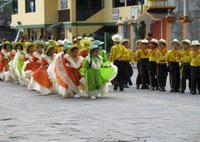
Kids on parade

Dogs on rooftops

Vendors on busses selling fruit, shishkabobs, sunglasses, herbal remedies, CDs, razors, wallets, and anything else they can think of

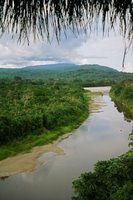
The jungle and swimming in the river


Neighbors sitting outside on their patios chatting, literally, for hours

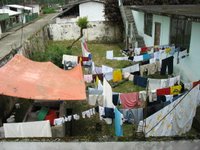
Fields of laundry


Musical garbage trucks—On garbage day, the trucks drive up and down the streets playing a music-box tune to let people know they should bring their garbage out to the curb. Although the streets are littered, people don’t leave garbage bags out because the trash will rot in the humidity or be torn to bits by stray dogs.

Entrails and meat cuts hanging in open-air butcher shops

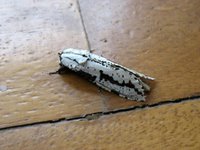
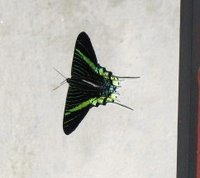
Impressive insects—I discovered the black butterfly, with a wingspan the length of my hand, inside the house

Labels: , ,

Tuesday, March 14, 2006

Guayaquil: The Extreme City

If you spend much time in Quito, the political capital of Ecuador, you get accustomed to hearing stories about Guayaquil, the economic capital of Ecuador. The huge port city is twice as populous and sprawling as mountainous Quito, is sweltering with humidity much of the year, has an even more extreme gap between rich and poor, and is supposedly riddled with thieves and murderers. Being from Oakland, I wasn’t overly daunted by this last fact, plus I was going to get a brief tour of the city from a local whom I figured could help me stay safe and alert.

My guide was Lupe, born and raised in Guayaquil. She is a doctor who works in the city four days a week, then travels 3 hours each way by bus to work in rural communities every weekend. She’s a small woman (at 5’2”, I tower over her) but formidable. She speaks at close to the speed of light, tells you exactly what she thinks, and uses her hands to dramatic and sometimes dangerous effect, especially if you are a non-native speaker leaning in close to try to understand what she’s saying.

She met me at the airport and launched into a detailed, rapid-fire story about her work, all the while leading me across a busy six-lane thoroughfare to catch a bus to her house. I realized then that thieves and murderers would probably be the least of my problems. Following the story, keeping track of my belongings, and trying not to get run over by maniacal drivers gave me a new appreciation for the term “multi-tasking”. By the time we squeezed onto the bus and Lupe, my bags, and I wedged into the last two hard plastic seats, I was exhausted. I’d been in Guayaquil 15 minutes.

I still don’t know what exactly Lupe said or what exactly I saw on the bus ride to her house. My receptors were on overdrive. But once I let go of the hope that I could make sense of things, I started to enjoy the chaos. I know we passed a lot of small, crammed together cinderblock buildings with rusty signs. The storefronts were blocked by bars, like at a bank teller window, through which people exchanged cash for soap, fruit, beer, diapers, or whatever else was on the shelves. People were out and about in shorts and flip flops, and we passed a lot of small restaurants that grilled all kinds of animal innards in big street side barbecues.

Lupe lives with her mother, father, sister, brother-in-law, and eight-month-old nephew in a working-class neighborhood in Guayaquil, which means she lives in a poor, but not desperate, part of the city. Although Lupe comes from a family of professionals—one sister is a pediatrician, another is a teacher, and one of her brothers is an accountant—they earn less than an Ecuadorian middle-class wage. Their house is their only investment. It’s an attractive if quirky building: stairs take you up a flight so you can go down a level and doors seem to appear out of nowhere. After spending a few hours there, I got the hang of the layout, in which everyone has individual space, though most of the time the family is together in the living or dining room.

Lupe and I ate lunch with her sister and mother, who welcomed me like their favorite neighbor who’d just come back from a long trip. We talked about the kind of food I like, how Arnold Schwarzenegger ended up as governor of California, the pending Andean Free Trade Agreement, Ecuadorian celebrities, and the weather. They also made sure I knew what a fabulous city Guayaquil is, from the climate to the variety of things to do to the major economic interests controlling the country from their hometown. Later, Lupe took me on a tour that began as an errand to buy an AIDS prevention video for the health promoters she works with, and that’s when I got a taste of the city her family described.

A couple blocks from her house, we caught the bus near the tributary of the river that runs through Guayaquil, one of the filthiest I’ve ever seen. Trash floated on the caramel-colored water, which rose to the level of the houses that seemed to grow out of the weeds. The bus dropped us off somewhere near the commercial center. I followed Lupe through an immense warren of stalls selling everything, including more bootlegged videos than I’ve ever seen in my life. Lupe, of course, charged through the maze with utter confidence, while I clutched my purse to my side and hustled to keep up with her, lest I be lost in Ecuador’s answer to Marrakech. Then we emerged from the central market onto a vast tree- and skyscraper-lined boulevard and walked several blocks to the Malecon, which fronts the river. But here, the water gleamed a natural green and reflected the thick cumulus clouds and lush ve
getation on the opposite bank. And the Malecon itself is a marvel—several miles of boardwalk comprised of botanical gardens, modern sandstone and metal architecture, impressive monuments to Ecuador’s founding fathers, museums, shopping, and gourmet restaurants. The Malecon is proof that Guayaquileños have a vision for a world-class city.

The Malecon leads to an artsy hillside neighborhood called Cerro Santa Ana, a collection of colorful houses, restaurants, shops, bars and galleries. We climbed more than 400 steps to the top of the hill where a new lighthouse, modeled on the original from the 1800s, sits. From there, you have a remarkable view of the city and where the money goes. Directly below the summit is a slum slated for redevelopment as a tourist complex, to the east is the Malecon and the business district, farther afield is the area where Lupe and her family live, which was paved with streets and sidewalks just a few years ago. Next on the city’s list, Lupe told me, is to clean up the river that runs through her neighborhood. Short as my trip was to Guayaquil, I got the impression that just as the people, the weather, and the pace of life are more intense, the process of correcting imbalances between rich and poor is probably that much more painstaking, and changes that much more hard won. But perhaps those incremental victories are part of what makes Lupe so proud of her hometown.

Labels: , , ,